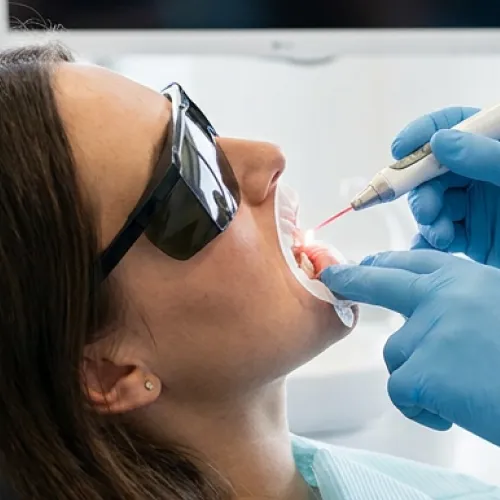
Gum Contouring Recovery: What to Eat, How Much It Hurts, and How Long It Takes
Wondering about gum contouring recovery? Learn about pain levels, healing time, and what to eat. Contact Prestige Dental today to schedule your consultation!
Read More

Emergency Dentistry
A crown is supposed to feel like a fresh start. A stronger bite. A tooth you can trust again. But sometimes, after the crown is placed, your gums start sending little signals you did not expect. Soreness that lingers. A bit of bleeding when you floss. A tender spot that seems to flare up at random.
Here’s the good news. Most crown and gum issues are fixable, especially when you catch them early. And often, they are not about the crown being “bad.” They are about the fit, the finish, the gumline environment, and the habits that keep that area calm.
This is the part many people do not hear enough: crowns do not just restore teeth. They also change the neighborhood your gums live in. If the gumline is happy, crowns can last for years and years. If the gumline is irritated, even a beautiful crown can become a constant annoyance.
Below, we’ll walk through what’s normal, what’s not, and what actually helps your gums stay healthy around a crown.
Your gums are protective. They form a seal around your teeth and help keep bacteria from sneaking deeper. When you get a crown, the dentist is essentially rebuilding the tooth’s outer shape, including the area that sits close to the gumline.
That means crown design matters, especially here:
A well-made crown should feel smooth, easy to clean, and “invisible” to your gums over time.
Gum irritation around crowns usually falls into a few buckets. Some are short-term and settle down. Others need a quick adjustment.
Here are the most common culprits:
If your gum is sore, bleeding, or puffy around a crown for more than a week or two, that is worth checking. It is usually a small fix, not a major redo.
Soreness can mean a few different things, and the details matter. Think about the pattern.
Soreness that is normal early on:
Soreness that should be checked:
Often, the “why” is one of these:
What you can do at home (short term):
What you should not do:
If the soreness lasts, Prestige Dental can examine the margin, check for trapped cement, and confirm your bite is balanced.
This is a big one, because people use the word “gap” to describe a few different things.
1) A visible dark line at the gumline:
If you see a thin line where the crown meets the tooth, it could be:
A visible line does not always mean the crown is failing, but it can mean the gumline has shifted or the margin needs evaluation.
2) A space that traps food:
If food consistently catches at the crown, that is not something to ignore. Food traps can lead to:
3) A crown margin that is not sealed well:
This is more technical, but important. A crown should have a close, smooth transition at the margin. If the margin is open, bacteria can slip in.
So should there be a gap?
If you suspect a real gap, it is worth a professional look. A quick exam can tell whether it is a harmless cosmetic issue, mild gum recession, or something that needs adjusting.
Gum recession around a crown can happen for reasons that have nothing to do with the crown itself, including brushing style, genetics, or inflammation. But crowns do change the cleaning environment, so prevention is all about keeping the gumline calm and plaque-free.
Brush like you are polishing, not scrubbing.
Floss in a crown-friendly way.
Use helpful tools if you have tight spaces or bridges.
If you grind or clench, protect the crown and the gums. Grinding can overload the tooth and irritate the surrounding tissue. A night guard can help prevent micro-movement and inflammation.
Keep up with cleanings. Crowns have margins. Margins attract plaque. Regular professional cleaning helps keep the gumline stable.
Watch for inflammation early. Gums that bleed are usually gums that are inflamed. Treat bleeding as a signal, not a nuisance.
Even with perfect home care, a crown that is slightly over-contoured or has a rough margin can keep gums irritated. If your gums keep acting up around a crown, the solution might be as simple as:
Book an appointment soon if you notice:
Call promptly if you notice:
A crown should not leave you constantly wondering if something is wrong. If your gums feel sore, look puffy, or keep bleeding around a crown, you are not being picky. You are paying attention, and that is how you protect your smile long-term.
If you have a crown that doesn’t feel quite right, schedule a visit with Prestige Dental. We can check the gumline, evaluate the crown’s fit and contour, and help you get back to a crown that feels smooth, clean, and comfortable.



Mon - Thur 9am-5pm
Wed Closed
Tue - Fri 9am-5pm
Sat - Sun Closed
312 W. Bass St.
Kissimmee, FL 34741
Local Dentist in Kissimmee, FL