Best Mouthwash for Gum Disease: What Actually Works (and What Doesn't)
Looking for the best mouthwash for gum disease? Discover what works to fight gingivitis, top alcohol-free rinses, and expert picks. Read our full guide today!
Read More
Restorative Dentistry
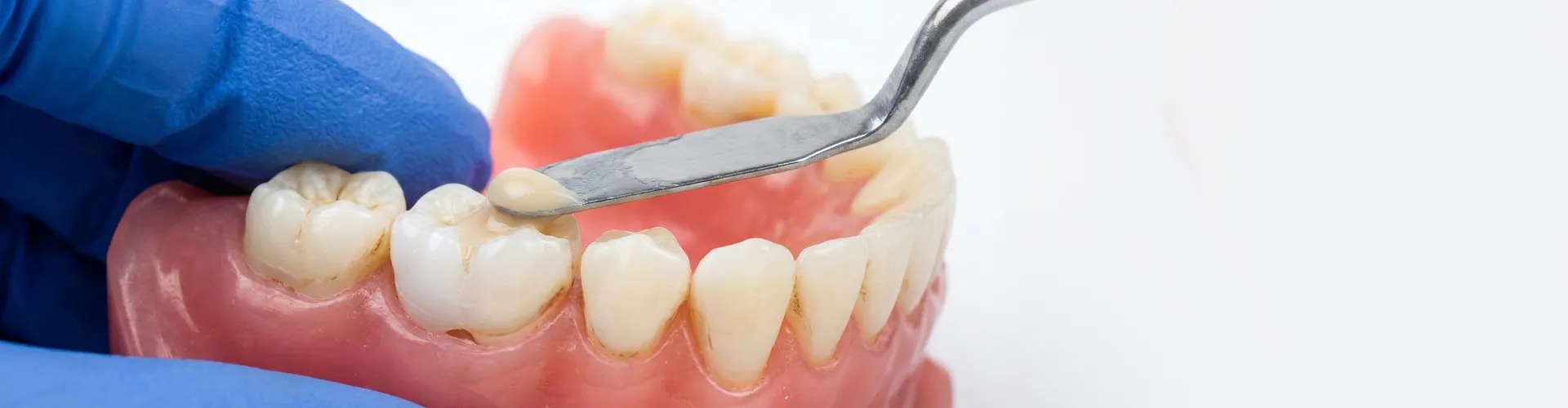
A chipped filling isn't just a cosmetic problem — it can become a bacterial trap that quietly destroys the dentin underneath. Whether your filling can be repaired depends on where it chipped, and whether a filling strengthens or weakens your tooth depends entirely on the material and its bonding chemistry.
Most people focus on the missing piece of material. The real threat is invisible. For Kissimmee-area patients, understanding the risks of a compromised restoration is vital.
When a filling chips, it breaks the hermetic seal between the restorative material and your tooth. That gap may be too small to feel with your tongue, but it's large enough for bacteria to colonize. According to the NIDCR, decay-causing bacteria produce acid that progressively dissolves enamel and the softer dentin layer beneath it.
Dentin is significantly more porous than enamel. Once bacteria breach the seal, they don't just sit at the surface — they work inward along the dentin tubules. The filling can appear mostly intact from the outside while the internal tooth structure quietly softens beneath it. By the time sensitivity or pain appears, the decay may already be extensive.
This is what dentists call secondary caries — decay that forms under an existing restoration. WebMD's oral health coverage notes that constant pressure from chewing can cause fillings to chip or crack, and that weaknesses in restorations are often only detectable during a professional cleaning and exam — not by the patient at home.
The takeaway: don't wait for pain before addressing a chipped filling. The danger isn't the missing material itself. It's the biological cascade that begins the moment the seal is broken.
Not every chipped filling requires full replacement. But the decision isn't about how big the chip is — it's about where it occurred.
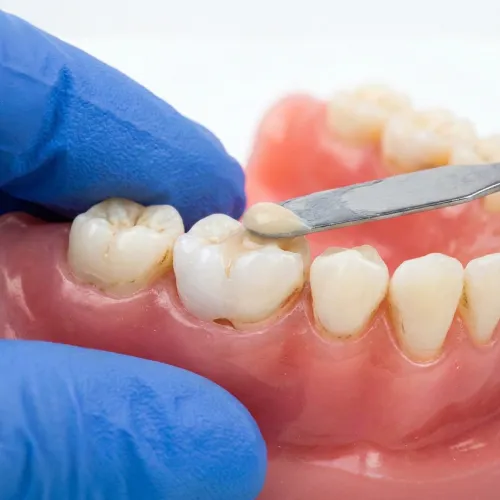
Marginal chips happen at the edge where the filling meets the tooth. These are often candidates for repair. A flowable composite resin can reseal the margin, restoring the hermetic barrier and stopping bacterial ingress before secondary decay takes hold. Healthline's guide to chipped teeth confirms that minor chips can often be addressed in a single office visit using bonding techniques.
Functional cusp chips are a different matter entirely. The biting surfaces of your back teeth absorb significant force — well over 100 pounds per square inch during normal chewing. A patch applied to a load-bearing cusp simply cannot withstand that pressure long-term. In these cases, a full filling replacement or tooth crown is typically the appropriate solution, not a surface repair.
The distinction matters because applying a patch to the wrong location creates a false sense of security. The repair may look fine initially, but cyclic chewing forces will cause the patch to fail — often faster than the original filling — while secondary decay continues underneath.
If your filling has chipped, a dentist needs to assess both the location and the integrity of the remaining tooth structure before recommending repair or replacement.
Here's a question patients rarely think to ask: does the filling itself affect how strong the surrounding tooth becomes over time?
The answer depends on the material — and the biomechanics are worth understanding.
Older metal (amalgam) fillings are held in place by mechanical undercuts, not chemical bonding. Over years, amalgam undergoes thermal expansion and a slow deformation called "creep." As the metal shifts, it can exert outward pressure on the surrounding tooth walls — a phenomenon sometimes described as the "wedge effect." This internal hoop stress is one reason why teeth with large, aging amalgam fillings are more prone to vertical crack lines and cusp fractures over time.
Modern tooth-colored composite resin works differently. Because it bonds chemically to the tooth structure, it can actually splint the remaining cusps together, providing a degree of internal bracing. Research published on PMC examining the biomechanical performance of resin composite confirms that bonding chemistry plays a meaningful role in how restorative materials interact with surrounding dental tissue.
That said, no filling is permanent. Harvard Health's overview of dental trauma notes that a larger chip may require a crown to properly protect the remaining tooth structure — particularly when significant enamel or dentin has already been lost. In some cases, when decay has reached the inner pulp, an endodontic root canal may also be necessary before a crown can be placed.
The practical implication: a well-bonded composite filling in a tooth with sufficient remaining structure can support and protect that tooth. A large, aging amalgam filling in a heavily restored tooth may be quietly working against it.
The honest answer is: it depends on the condition of the filling, the material used, and how much natural tooth structure remains.
A well-placed, properly bonded composite filling in a tooth with healthy remaining walls can reduce fracture risk by stabilizing the structure. When cusps are bonded together, they resist the splitting forces that cause catastrophic fractures.
However, a filling that has chipped, aged, or lost its marginal seal shifts the equation. Secondary decay softens dentin from within. A tooth with softened internal structure is far more vulnerable to fracture under chewing load — even if the filling surface looks intact. Healthline's tooth restoration overview notes that crowns are specifically recommended for weak or cracked teeth, precisely because a filling alone cannot protect structurally compromised enamel walls.
The size of the cavity also matters. Larger restorations leave thinner tooth walls. Thinner walls mean less resistance to the bending forces generated during chewing. This is why dentists sometimes recommend transitioning from a large cavity filling to a crown — not because the filling failed cosmetically, but because the remaining tooth walls can no longer safely absorb the load on their own.
Regular dental check-ups allow your dentist to monitor filling integrity, identify marginal breakdown early, and intervene before secondary decay or fracture occurs. Left untreated, advanced decay can also contribute to gum disease, compounding the damage to your overall oral health.
If you have a chipped filling, sensitivity around an older restoration, or questions about whether your current fillings are protecting your teeth — don't wait for pain to make the decision for you.
Prestige Dental serves patients throughout Kissimmee and the greater Central Florida area. Our family dentistry team can evaluate your existing restorations, identify early signs of marginal breakdown or secondary decay, and recommend whether repair or replacement is the right path forward for your specific situation.
Book your evaluation today.
This article is intended for informational purposes only and does not constitute dental or medical advice. Always consult a licensed dental professional regarding your specific oral health needs.

Mon - Thur 9am-5pm
Wed Closed
Tue - Fri 9am-5pm
Sat - Sun Closed
312 W. Bass St.
Kissimmee, FL 34741
Local Dentist in Kissimmee, FL


