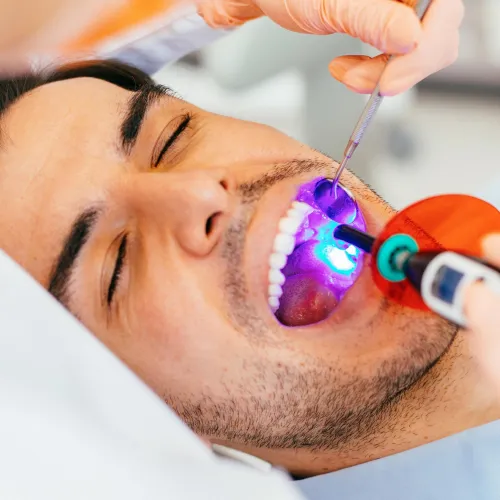
Does Whitening Toothpaste Actually Work or Is It Damaging Your Teeth?
Does whitening toothpaste actually work or damage enamel? Learn why your teeth may still look yellow and discover safe whitening tips from Prestige Dental.
Read More
Restorative Dentistry
Not all dental fillings are created equal — the "healthiest" choice depends on your cavity size, location, health history, and even your body's chemistry. This guide breaks down the most common filling materials, their real-world trade-offs, and what questions to ask your dentist before treatment.
Most patients searching for a "healthy" filling assume the answer is simply avoiding amalgam. That's understandable — but it's incomplete.
For Kissimmee patients, composite resin fillings are often marketed as the natural, non-toxic alternative. And for most patients, they are an excellent choice. But composite resins contain monomer compounds — including TEGDMA, UDMA, and HEMA — that can trigger inflammatory or allergic responses in patients with autoimmune conditions, mast cell activation syndrome, or known chemical sensitivities. "BPA-free" labels don't account for these proprietary matrix monomers.
If you have a complex autoimmune history, ask your dentist about Clifford Materials Reactivity Testing (CMRT). This serum-based compatibility test screens your blood against specific filling formulations — composite brands, ceramic systems, and bonding agents — to identify materials your immune system is less likely to react to. It's not standard practice, but it's a legitimate option for patients who need it.
For patients who don't have chemical sensitivities, composite resin remains a strong choice. According to Healthline, composite is a mixture of acrylic resin reinforced with powdered glass, customizable to match your tooth shade, and bonds directly to tooth structure — which means less removal of healthy enamel compared to amalgam.
The takeaway: "healthiest" isn't one-size-fits-all. It's the material that performs well clinically and works with your individual biology. A good starting point is a thorough cleaning and exam so your dentist can assess your cavity risk, existing restorations, and overall oral health before recommending any filling material.
Here's a distinction that rarely appears in standard filling comparisons: the difference between inert and bioactive filling materials.
Most composite resins are passive. They fill the space, they stop the decay, and they sit there. They don't interact with your tooth chemistry after placement. For most healthy patients, that's fine.
But for patients with dry mouth (xerostomia), high acid erosion, or an active history of cavities, a passive material may not be the best fit. This is where Glass Ionomer Cements (GIC) and Giomers offer something composites can't.
GIC releases fluoride continuously after placement, acting as a rechargeable mineral reservoir. Saliva recharges the material with fluoride from toothpaste and rinses, which then leaches back into surrounding enamel — actively arresting recurrent decay at the margins. The NIDCR notes that composite resin materials are increasingly common, but the choice of filling material should account for individual patient factors, not just aesthetics.
Giomers are a hybrid: they combine the fluoride-releasing properties of GIC with the polish and durability of composite resin, making them a compelling option for patients at elevated caries risk who still want a tooth-colored result.
GIC isn't appropriate for large, high-pressure cavities — it's less durable under heavy chewing forces. But for root surface decay, near-gumline restorations, or pediatric patients, its therapeutic benefit outweighs its mechanical limitations. Patients with a history of gum disease gingivitis are especially prone to root surface decay, making bioactive material selection particularly relevant for this group.
Composite fillings have a well-known list of disadvantages: they're more technique-sensitive, they may discolor over time, and they typically don't last as long as amalgam. Research published on NCBI found statistically higher rates of restoration failure and secondary caries in composite versus amalgam restorations in children, which underscores that material performance is inseparable from clinical conditions.
The single biggest clinical flaw of composite resin — one that competitor articles almost never explain to patients — is its extreme sensitivity to moisture during placement.
Composite resin requires an etch-and-bond phase. If saliva, blood, or even humidity contaminates the bonding surface during this window, the adhesive layer fails. The result isn't immediately visible, but over months or years it produces marginal gaps where bacteria infiltrate — leading to secondary decay under the filling.
What patients should ask before a composite filling is placed:
This isn't about doubting your dentist. It's about understanding that a technically excellent composite placed under ideal isolation outperforms a rushed placement every time. When decay is caught early through routine cavity fillings, the preparation is smaller and isolation is easier to achieve — another reason preventive care directly affects restoration outcomes.
The ADA's MouthHealthy resource encourages shared decision-making between patient and dentist, with material choice driven by cavity size, location, aesthetics, and individual factors.
Here's how the main options compare:
No single material wins across all categories. The healthiest filling is the one placed correctly, in the right location, for the right patient.
If you're in Kissimmee or the greater Orlando area and want to discuss which filling material fits your health history and dental needs, Prestige Dental is here to help. Our team offers comprehensive family dentistry services and takes time to understand your individual situation before recommending any treatment — because the best dental care is always personalized.
Medical disclaimer: This article is for informational purposes only and does not constitute medical or dental advice. Always consult a licensed dental professional for diagnosis and treatment recommendations specific to your situation.


Mon - Thur 9am-5pm
Wed Closed
Tue - Fri 9am-5pm
Sat - Sun Closed
312 W. Bass St.
Kissimmee, FL 34741
Local Dentist in Kissimmee, FL